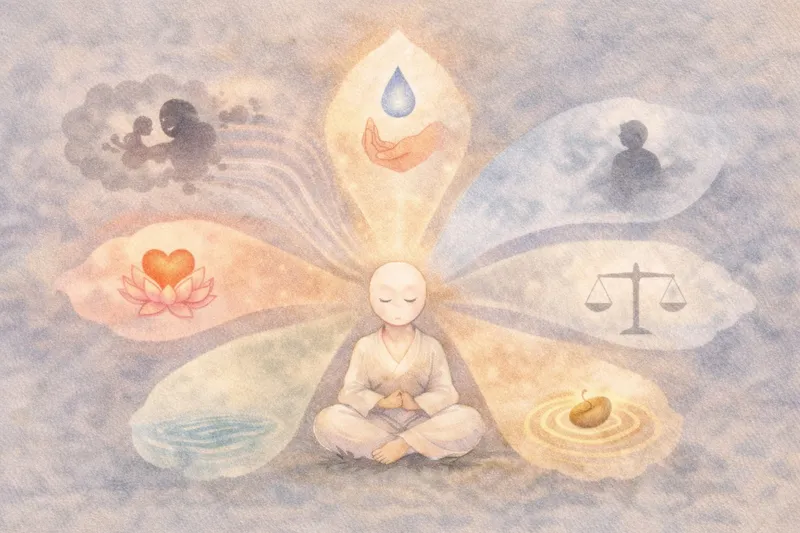
Five ways for removing arisen resentment - 1) loving-kindness, 2) compassion, 3) equanimity, 4) disregarding and non-attention, 5) reflection on kamma.
“Pañcime, bhikkhave, āghātapaṭivinayā yattha bhikkhuno uppanno āghāto sabbaso paṭivinetabbo. Katame pañca?
Bhikkhus, there are these five ways for removing |resentment::annoyance, irritation, loathing; lit. collision [āghāta]| by means of which resentment that has arisen in a bhikkhu should be completely removed. What five?
Yasmiṁ, bhikkhave, puggale āghāto jāyetha, mettā tasmiṁ puggale bhāvetabbā; evaṁ tasmiṁ puggale āghāto paṭivinetabbo.
1.) Bhikkhus, in whomever resentment might arise, |loving-kindness::goodwill, friendliness, benevolence [metta]| should be cultivated toward that person. Thus, the resentment toward that person should be removed.
Yasmiṁ, bhikkhave, puggale āghāto jāyetha, karuṇā tasmiṁ puggale bhāvetabbā; evaṁ tasmiṁ puggale āghāto paṭivinetabbo.
2.) Bhikkhus, in whomever resentment might arise, |compassion::mental quality of wise empathy in response to suffering, which counters qualities of harm or cruelty [karuṇā]| should be cultivated toward that person. Thus, the resentment toward that person should be removed.
Yasmiṁ, bhikkhave, puggale āghāto jāyetha, upekkhā tasmiṁ puggale bhāvetabbā; evaṁ tasmiṁ puggale āghāto paṭivinetabbo.
3.) Bhikkhus, in whomever resentment might arise, |equanimity::mental poise, mental balance, equipoise, non-reactivity, composure [upekkha]| should be cultivated toward that person. Thus, the resentment toward that person should be removed.
Yasmiṁ, bhikkhave, puggale āghāto jāyetha, asatiamanasikāro tasmiṁ puggale āpajjitabbo; evaṁ tasmiṁ puggale āghāto paṭivinetabbo.
4.) Bhikkhus, in whomever resentment might arise, disregarding and non-attention should be applied toward that person. Thus, the resentment toward that person should be removed.
Yasmiṁ, bhikkhave, puggale āghāto jāyetha, kammassakatā tasmiṁ puggale adhiṭṭhātabbā: ‘kammassako ayamāyasmā kammadāyādo kammayoni kammabandhu kammapaṭisaraṇo, yaṁ kammaṁ karissati kalyāṇaṁ vā pāpakaṁ vā tassa dāyādo bhavissatī’ti; evaṁ tasmiṁ puggale āghāto paṭivinetabbo.
5.) Bhikkhus, in whomever resentment might arise, reflection on kamma should be determined toward that person: ‘This venerable is the owner of his actions, heir to his actions, born of his actions, related to his actions, supported by his actions. Whatever actions he does, whether good or bad, he will be the heir of those.’ Thus, the resentment toward that person should be removed.
Ime kho, bhikkhave, pañca āghātapaṭivinayā, yattha bhikkhuno uppanno āghāto sabbaso paṭivinetabbo”ti.
Bhikkhus, these are the five ways to remove resentment by means of which resentment that has arisen in a bhikkhu should be completely removed.
Bhikkhus, there are these five ways for removing |resentment::annoyance, irritation, loathing; lit. collision [āghāta]| by means of which resentment that has arisen in a bhikkhu should be completely removed. What five?
1.) Bhikkhus, in whomever resentment might arise, |loving-kindness::goodwill, friendliness, benevolence [metta]| should be cultivated toward that person. Thus, the resentment toward that person should be removed.
2.) Bhikkhus, in whomever resentment might arise, |compassion::mental quality of wise empathy in response to suffering, which counters qualities of harm or cruelty [karuṇā]| should be cultivated toward that person. Thus, the resentment toward that person should be removed.
3.) Bhikkhus, in whomever resentment might arise, |equanimity::mental poise, mental balance, equipoise, non-reactivity, composure [upekkha]| should be cultivated toward that person. Thus, the resentment toward that person should be removed.
4.) Bhikkhus, in whomever resentment might arise, disregarding and non-attention should be applied toward that person. Thus, the resentment toward that person should be removed.
5.) Bhikkhus, in whomever resentment might arise, reflection on kamma should be determined toward that person: ‘This venerable is the owner of his actions, heir to his actions, born of his actions, related to his actions, supported by his actions. Whatever actions he does, whether good or bad, he will be the heir of those.’ Thus, the resentment toward that person should be removed.
Bhikkhus, these are the five ways to remove resentment by means of which resentment that has arisen in a bhikkhu should be completely removed.
“Pañcime, bhikkhave, āghātapaṭivinayā yattha bhikkhuno uppanno āghāto sabbaso paṭivinetabbo. Katame pañca?
Yasmiṁ, bhikkhave, puggale āghāto jāyetha, mettā tasmiṁ puggale bhāvetabbā; evaṁ tasmiṁ puggale āghāto paṭivinetabbo.
Yasmiṁ, bhikkhave, puggale āghāto jāyetha, karuṇā tasmiṁ puggale bhāvetabbā; evaṁ tasmiṁ puggale āghāto paṭivinetabbo.
Yasmiṁ, bhikkhave, puggale āghāto jāyetha, upekkhā tasmiṁ puggale bhāvetabbā; evaṁ tasmiṁ puggale āghāto paṭivinetabbo.
Yasmiṁ, bhikkhave, puggale āghāto jāyetha, asatiamanasikāro tasmiṁ puggale āpajjitabbo; evaṁ tasmiṁ puggale āghāto paṭivinetabbo.
Yasmiṁ, bhikkhave, puggale āghāto jāyetha, kammassakatā tasmiṁ puggale adhiṭṭhātabbā: ‘kammassako ayamāyasmā kammadāyādo kammayoni kammabandhu kammapaṭisaraṇo, yaṁ kammaṁ karissati kalyāṇaṁ vā pāpakaṁ vā tassa dāyādo bhavissatī’ti; evaṁ tasmiṁ puggale āghāto paṭivinetabbo.
Ime kho, bhikkhave, pañca āghātapaṭivinayā, yattha bhikkhuno uppanno āghāto sabbaso paṭivinetabbo”ti.